

Inside GRAES' Mission to Simplify Skincare
How a biology major turned VC turned founder channeled three generations of entrepreneurship into a skincare brand built on science, simplicity, and zero trade-offs

Welcome to The Org Chart, the newest newsletter series from Beauty People, profiling the founders and industry insiders who are quietly (or not so quietly) reshaping beauty through vision and intention, with conversations that go beyond product talk.
These are the names to know, the stories to remember, the routines to bookmark, and the voices shaping beauty today.
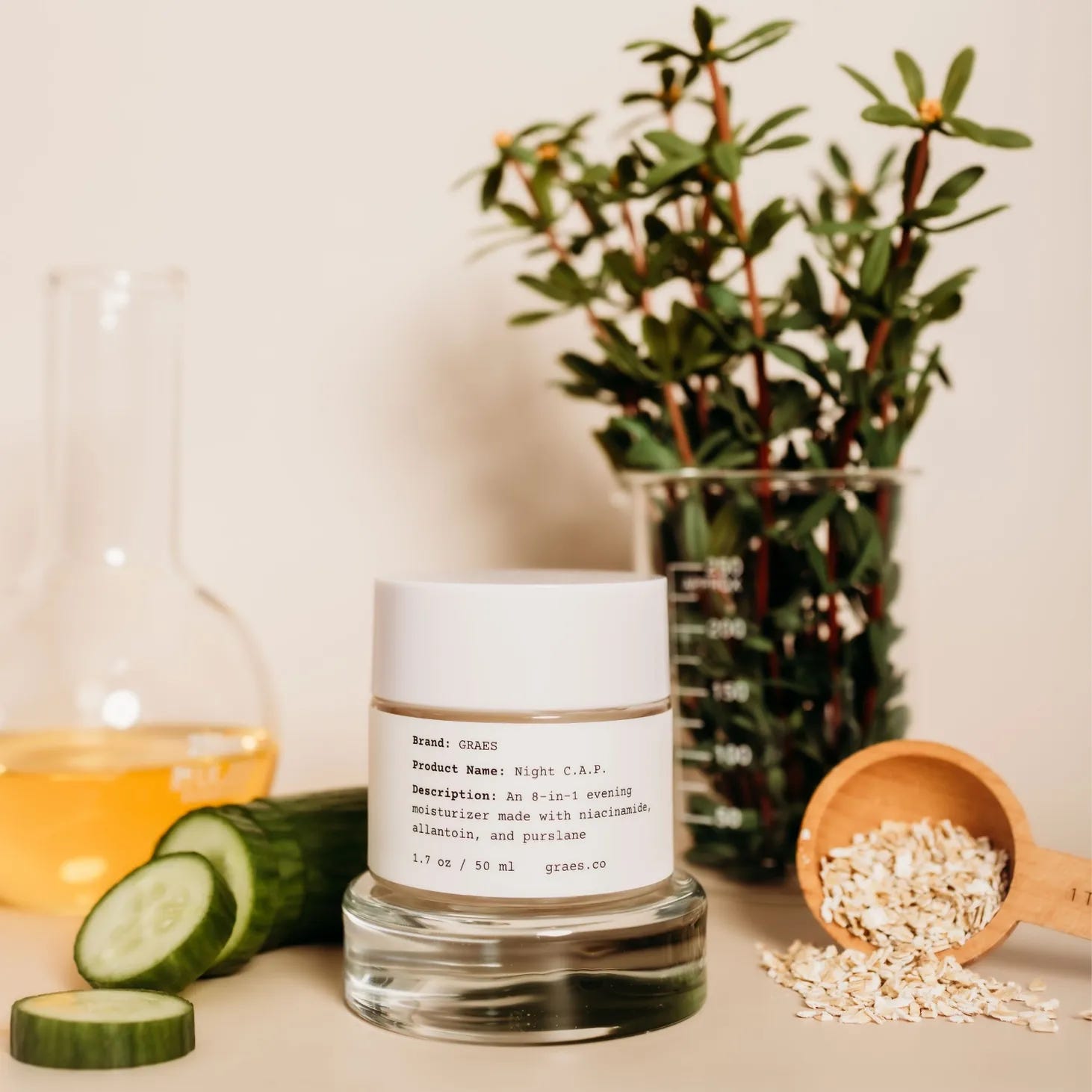
Becky grew up in a family of entrepreneurs, from her great-grandfather, who co-owned the Boston Celtics, to her father, who co-founded an immunoinformatics company. Starting a business, it seems, runs in her blood! Entrepreneurship runs in her family, but GRAES started with her own skin. Struggling with sensitive, reactive skin from childhood through her twenties, Becky realized that even the best active ingredients weren’t enough, and that avoiding irritants is just as critical. After years of research, testing, and running a product review site, she created GRAES, a skincare brand designed to simplify routines (as she once had a 15-step skincare routine), reduce plastic waste, and deliver maximalist results in minimal steps. Her first product, Night C.A.P., is an 8-in-1 night cream built to save time, space, and stress while caring for your skin and well-being.
Growing up in a family with such a rich history of entrepreneurship, did you always know you wanted to start your own business, or did that idea come later?
A part of me always wanted to start a business; I just didn’t know what it was going to be for a long time. I spent a lot of my 20s coming up with ideas: blogging, drop shipping, print on demand, vintage on Etsy. I was all over the place. Ultimately, none of those ideas turned into anything meaningful because I just wasn’t passionate enough to drive them there. Even with GRAES, I wasn’t positive I wanted to move forward with the idea. I was just trying to solve my own problems. Then, eventually, I decided it was a problem worth solving for as many people as possible.
Your great-grandfather, grandfather, and father all built very different kinds of businesses. What lessons or stories from them stuck with you the most?
The family is kind of all over the place! Looking back on each of their careers, it’s clear that you can be an entrepreneur for different reasons and with different personal goals in mind. My great-grandfather was a serial entrepreneur, mostly in the sports space, but he dabbled in just about everything. While I never met him, he sounds like what I call a “shark”. Sharks never stop swimming; if they do, they sink. That type of entrepreneur is in it for the growth and for the challenge of it all, and there’s always another deal around the corner.
My grandfather owned a local bakery specializing in meat pies. He valued routine and work-life balance; every day, he was done at the same time and would go to the local tennis club covered in flour for a few games before heading home for dinner. The news spends a lot of time covering “sharks” and VC darlings, but this is the most common type of business owner, and our whole country runs on these businesses.
My Dad is the cofounder of an immunoinformatics company that specializes in predicting the immunogenic potential of protein sequences. They predict whether your body will treat a protein as friend or foe. They’ve been bootstrapped for over 20 years, which is remarkable. I now have a new appreciation for just how crazy it is, because I’ve been bootstrapping for less than a year, and it is very stressful! Whenever it felt like time to walk away and find something easier, my Dad would decide he couldn’t because he had the chance to be involved in finding a cure for cancer. He’s in it for the impact.


Can you tell us about your career background before starting GRAES and how it prepared you for this journey? I love a good pivot story, and your VC and biology background is fascinating!
Thank you! I’ve always been a science and math nerd, and majored in Biology in college. I just love learning how things work. Unfortunately, working in the sciences, specifically drug discovery and development, is much different from learning about them. The process was incredibly slow, with plenty of dead ends, and I didn’t feel like I was moving the needle... I was just a cog in a machine that was going to take a decade or more to get to its final destination, with no guarantee it would work.
I think it is common for high achievers to accidentally “fail up”: they keep getting promoted and are doing a good job, but are miserable doing it. I went through a bout of depression in my mid 20s, and during that time, I remember feeling like taking care of myself, specifically personal care, was incredibly hard. I still had acne and a lot of other skin issues at the time, and kept impulsively buying products, hoping that this time it would work. Eventually, I leaned into my research background and stopped impulse buying based on marketing claims. I didn’t know then, but that was the start of my R&D process for what would become GRAES.
In the meantime, I pivoted my career and signed up for an online MBA during COVID. I’d discovered that I had a love of operations and process improvement, and wanted to pivot more towards the business side of things. I’m definitely not the typical VC resume, but I got into a firm after a warm intro and an offer to intern for free. I had a blast, but eventually got laid off when the macroeconomic climate shifted and the firm pivoted. I’ve done a few odd jobs here and there to keep the lights on, but I am mostly focusing solely on GRAES.
Tell us more about the name “GRAES.” What’s the story?
It’s a combination of two acronyms. “Generally Recognized As Effective” and “Generally Recognized As Safe”. GRAE is used in law as a shorthand for whether a particular argument will be successful in court, while GRAS is used in chemistry. Efficacy and safety are our two main pillars, so I named the brand after them. The story of how I got there was much less direct, though!
I originally wanted to name the brand Rāe, derived from the Latin word “curae,” meaning “care”. I ran into a trademark issue with this and needed to come up with something different, so I literally went through the alphabet, putting each letter in front of “rae” to see how it sounded. I liked “Grae” but couldn’t trademark it either, which is where the S came in. It was only after landing on GRAES that I realized it combined the two acronyms. Just goes to show that naming a brand isn’t always a eureka moment.
How would you describe the GRAES brand and the philosophy behind it? What makes GRAES different from other skincare brands on the market? Why GRAES?
Our guiding philosophy is to reduce the amount of friction involved in personal care. I want to create products that thread as many needles as possible: efficacy, safety, cost, simplicity, and sustainability. A lot of brands focus on one or two of these as selling points. I want customers to feel like they’re getting everything they’re looking for without any trade-offs.
The brand is quite minimalist and calm. I did the packaging and website design myself, with the help of some amazing friends. There may be a more professional rebrand in the future. But the feeling of the brand will stay the same. Discovering GRAES should feel like an exhale of relief, like something has finally been taken off your plate.
What was the biggest challenge during those five years of R&D before launching Night C.A.P.?
Being self-funded is a challenge in and of itself, and product development is expensive. Beyond the budget constraints, I also ran into formula issues. I was trying to get so many actives, at such a high concentration, that we had problems with the emulsification system. If you didn’t mix it just right, it would pill, which is one of the worst things in skincare! My first product developer actually dropped me because I was so specific about what I was looking for. Luckily, the next cosmetic chemist I worked with nailed it.
Your ingredient dictionary goes beyond what most brands share. Was that something you always knew you wanted, or did it evolve as you were developing GRAES?
It’s definitely something I always knew I wanted. Maybe it’s the science background, but as a consumer, I am always looking for as much data about a product as possible before I buy. I want to give that to my customers too. Everyone is so different in terms of sensitivities and buying preferences. If a GRAES product doesn’t work for someone, I’d like the site to at least give them a starting point for understanding why, so they can make better purchases in the future.
How do you hope GRAES changes the way people approach skincare and self-care?
The narrative that skincare is self-care has been consistently communicated in the industry for years now. It actually took me several years to realize that this isn’t the case for everyone, and that it wasn’t even the case for me. Yes, I like to look my best, but a lengthy process in order to get there doesn’t “fill my cup” in the way that self-care should. I hope that GRAES can offer a solution to other customers like me, giving them the end result without the 30 minutes in front of the mirror every day.
Looking ahead, where do you see GRAES going in the next few years?
My first goal with GRAES is to create a capsule wardrobe for your face: a cleanser, an optional essence, and a moisturizer for morning and evening. Each product and routine will be designed to deliver the best results you can get without being so potent that it risks irritation with daily use. If we can nail each formulation, customers shouldn’t need more than four to six items total.
And now my favorite Org question—what’s your beauty routine like?!
Skincare: My skin is super dry and sensitive, so my routine is hydrating all the way through. I will do a first cleanse with pure jojoba oil, which is the most chemically similar to our own sebum and keeps blackheads from building up. I follow that with a high glycerin content foaming cleanser. Right now, I’m using the one from Facile, but have also tried and liked Dieux’s Baptism, Prequel’s Gleanser, and The Brightening Cleanser from Indie Lee. After cleansing, I always go in with a hypochlorous acid spray to help prevent breakouts. I have the one from Magic Molecule. In the morning, I might apply a combination of chemical exfoliants and vitamin C if I feel like my skin needs it. I’m currently mixing 3 products for this step, which is a small peek into my product development process, haha. After that, I apply Night C.A.P., followed by SPF. For SPF, I am still trying to find that “holy grail”. I am sensitive to chemical filters, but also struggle to find a physical one that doesn’t give me a white cast or an orange tint, so this is another step where I am mixing products. I’m a fan of a more serum texture for this step, like Ultra Violette Future Screen or a few liquid options from First Aid Beauty. At night, I just apply Night C.A.P. mixed with my tretinoin prescription after the hypochlorous acid step.
Makeup: I actually don’t wear a ton of makeup anymore. When I do, I stick to BBLL: blush, brows, lashes, lips. I am really pale, so these four areas help me introduce more contrast to my face so I look less like a corpse, haha. I use Glossier Boy Brow or Kulfi’s Free The Brow gel, depending on whether I want pigment that day or not. For lashes, I can’t find anything that beats Glossier’s mascara. I will occasionally play with something slightly more volumizing for a night out. Right now, that’s Sarah Creal’s Back of the Cab mascara. It looks great, but anything more than Glossier’s formula tends to be noticeable for me, so I’ll end up trying to pull it off later in the night. For blush, my favorite red/brown color recently got discontinued (the worst!), so eventually I’m going to have to find a dupe. The Rhode pocket blush in Toasted Teddy looks the most promising, but I’m not going to replace it until I run out. I also recently purchased Hannah Louise Poston’s collaboration with Salt New York and am loving it. If you are someone who is looking for more desaturated colors, definitely check them out! It’s a great palette for adding color without feeling like you’ve gone overboard. For lips, I’m usually just using a clear balm. When I am adding color, it’s either the Kulfi lip stain in Rose/Tamarind or Glossier Generation G lipstick in Fuzz. I have a smattering of concealers in case I need them, but I almost never do anymore, which is nuts because I used to be afraid to leave the house without foundation. I will use Westman Atelier’s concealer under the eyes because it is “self-setting”, with a pat of the Kosas pressed setting powder to reduce shine under the eyes and in the T zone. If I’m really going all out, I will add eyeshadow. My eyes are fairly hooded, so I am not able to do a wing or anything like that. I tend to go for more of a grungy/messy, one-sparkly-color-all-over look. Roen’s quads are great for this and tend to be my favorite.
Body: For hair, I am a big fan of Hairstory’s New Wash, with Neutrogena’s T Sal shampoo as a clarifying option. I’m on an “Olsen Hair” journey, so I’ve been air drying with Ceremonia’s protectant, Captain Blankenship’s sea salt spray, and Roz’s root volumizer. For body, I am typically using Prequel’s Gleanser or the multi-oil body wash from Naturium.
Fragrance: I was an Acqua Di Gioia girl for a long time. Now I am playing around with fragrance a little bit more. My go-to combo is Goop’s This Smells Like My Orgasm (I know) with Chloé’s Rose Naturelle. However, in the winter, sometimes I will wear Armani’s My Way.
Want to get your hands on Night C.A.P? Use BEAUTYPEOPLE20 for 20% off your first purchase.
If you enjoyed this interview, consider restacking or letting me know your thoughts in the comments. Loved this interview? Follow GRAES by Becky on Instagram.
Thank you again for having me!!
LOVE this new series!